Embracing circularity

We turn yesterday´s facades into today´s building envelopes

“With 39% of global CO2 emissions and 75% of construction waste still not recovered (landfilled or incinerated),new regulations, taxonomies and laws are pushing for circular construction."
Lucile Souyri

Sustainability Manager HBS

From material to value – circular building

The path to the certified circular Economy

From challenge to business opportunity

It all starts with a conscious decision to dismantle selectively – to reduce waste and give materials a new lease of life through reuse and recycling.

For recycling to work, specialized systems and processes are required that can sort, dismantle, and recycle materials without compromising on quality – which is exactly how we work.

By rebuilding with recyclable products made from recycled materials, we are closing the loop for a truly sustainable future.
Discover more

By closing the loop on circular construction together, we can create a greener future. By tackling today's carbon footprint now—before new regulations come into force—we are not only helping to achieve the UN's goals, but also preserving the value of future assets.

Our certified products are developed with circularity in mind and help you achieve your sustainability goals in construction.

75% recycled, 95% recyclable

Building circularly requires more than just good intentions – it requires a strong network. Through our local network of metal builders, we give new life to materials after use.

As part of the Hydro Group, we bring raw materials back into the production cycle with full traceability and certification at every step. That's how we create value – for our customers, for the environment, and for the future.

Discover our solutions

Our method of embracing circularity

For almost a decade, sustainability has been at our core—thanks to game-changing collaborators who turn ambition into impact.

2024 marks an important step for us – for the first time, we are recycling aluminum from our own metal constructor and using it in our recycling plant. Today, we are able to follow the entire chain in our circular renovation projects.

Discover how we work

Our products consist of at least 75% recycled material and are 95% recyclable, offering low carbon solutions, and we report our environmental impact in a detailed EPD.

What is a dynamic EPD?

We can take back the scrap of your project

Talk to us about circular project solutions that reduce waste, reuse resources, and create long-term value with our sustainable aluminum windows, doors, and facades.

our role as a reliable force in circular renovation

Our role as a reliable force in circular renovation

  • STEP 1: There are vast resources in the existing building stock in the form of building materials that are currently not being utilized and instead end up in landfills or in downgraded recycling. Renovations generate large material flows with significant existing resources that should, as far as possible, be reused and recycled in a high-quality manner.

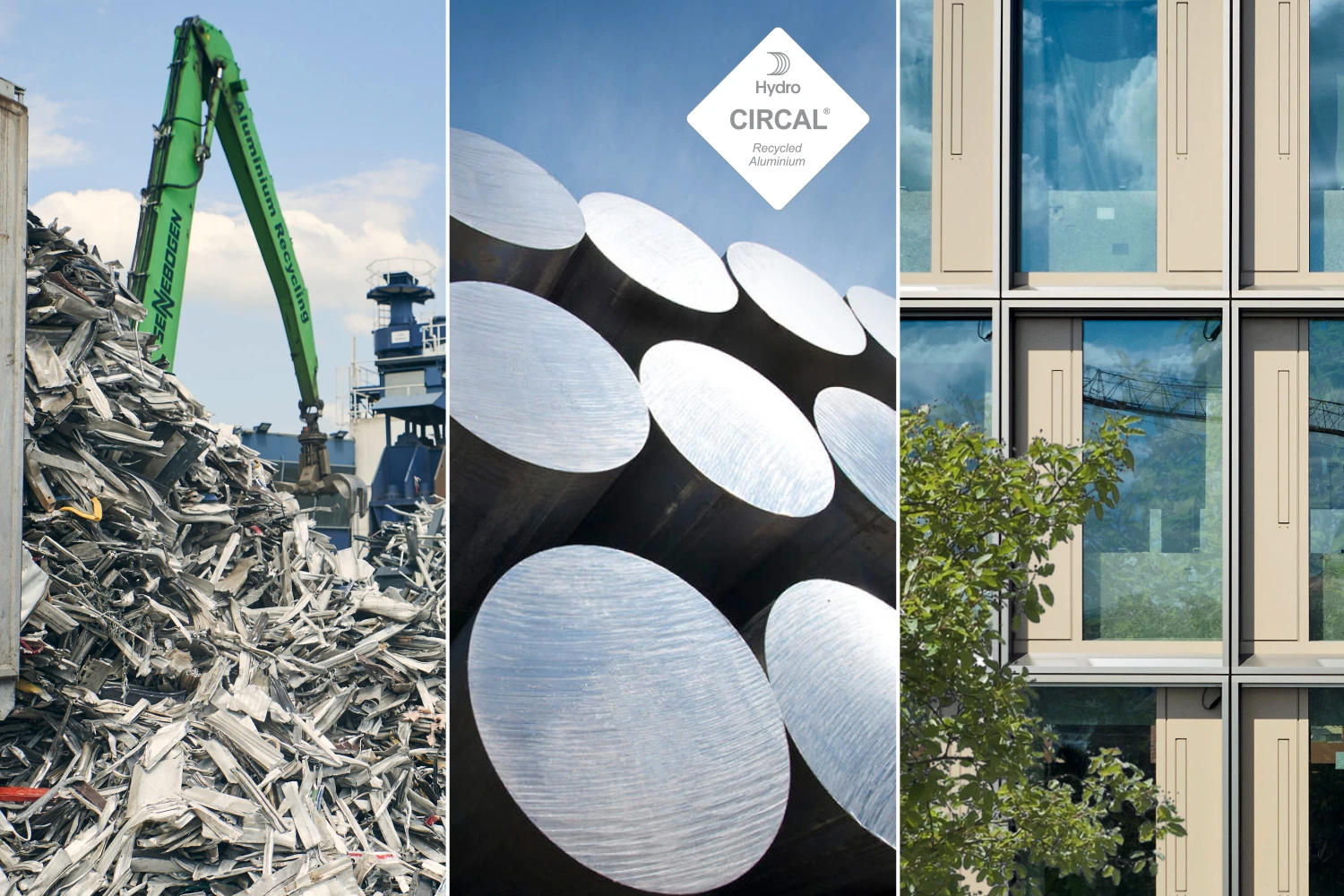
  • STEP 2: We offer a concept for the take-back of aluminum products that have reached the end of their lifecycle — a concept based on collaboration with manufacturers, industry partners, and clients. The main material component is structural aluminum, which retains all its properties and is infinitely recyclable.

  • STEP 3: Dismantling and sorting. Façade contractors dismantle windows, doors, and façades, disassembling frames and sashes, and separating EPDM seals and glass from the products. The aluminum material is collected by us, while EPDM and glass are collected by our partner suppliers. By returning the aluminum to us, all parties ensure smooth logistics and optimal traceability, making us a guarantor of a high-quality recycling loop.

  • STEP 4: Fragmentation and sorting. Through processes at our facilities, aluminum is separated from other materials as well as from undesired aluminum alloys. During the process, the aluminum is ground into chips that serve as raw material for the casting phase. Materials such as polyamide and EPDM are also separated, and the chip material is sent to line suppliers to be recycled into product components.

  • STEP 5: The recycled aluminum chips are melted into billets that form the basis for the next stage in production — saving 95% of the energy compared to the production of primary aluminum. The recycled aluminum forms the base of Hydro CIRCAL 75R, which reduces CO₂ emissions by 85% compared to the global average.

  • STEP 6: Return to raw material for the manufacturing of new products. The recycled aluminum is extruded and shaped through sustainable processes into profiles that form the foundation of our doors, windows, and façades. This process closes the loop, significantly reduces the CO₂ footprint, and serves as a model for circular economy.

  • STEP 7: New, updated products. Our doors, windows, and façades are designed to optimize energy efficiency, lifespan, and maintenance, and are engineered for easy disassembly and recycling. The products are made from 75% recycled content and designed according to circular principles, with 95% of all materials being recyclable.

  • STEP 8: Return to buildings. Unique QR codes on each product containing specific product data ensure full traceability, simplifying maintenance and future recycling. Through performance and design, the products already meet future requirements — thereby safeguarding the building’s long-term value.

We take care of our customers